 France
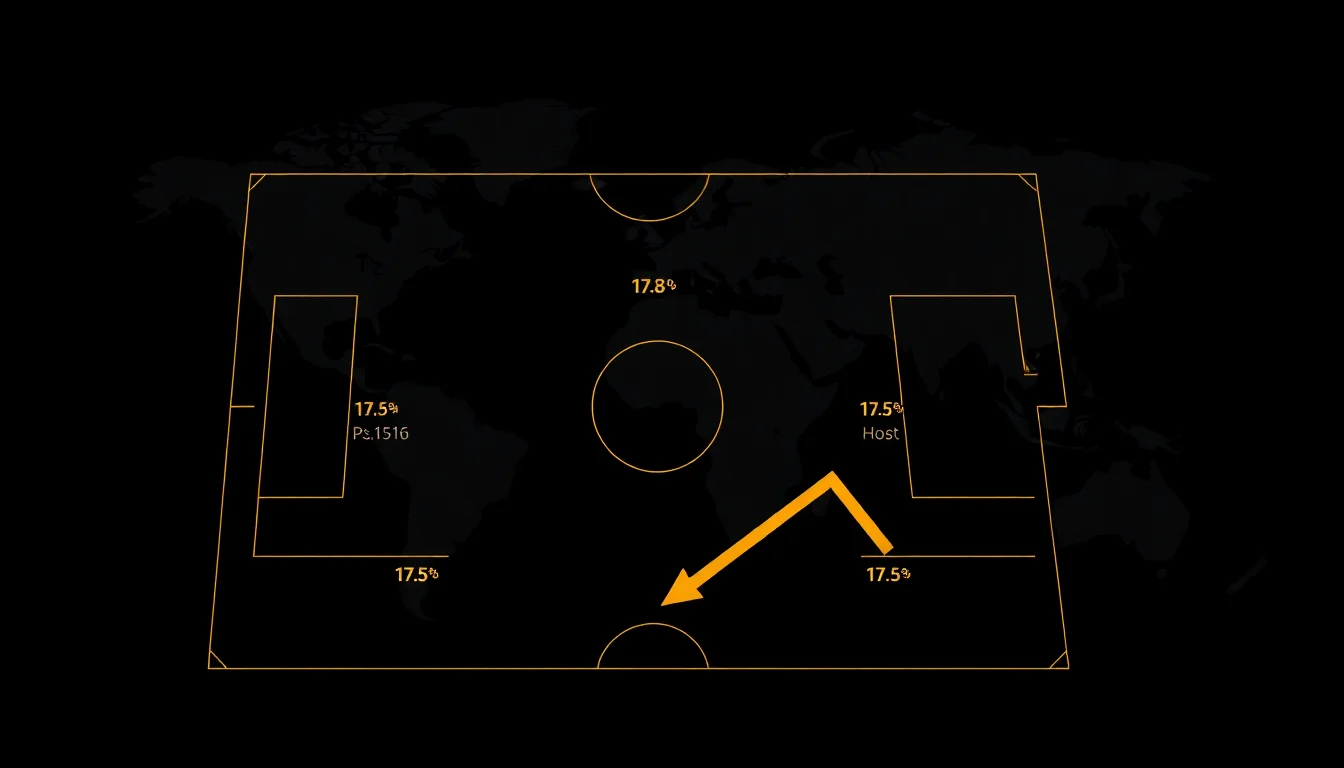
The market has caught up. France's midfield crisis is no longer a contrarian insight buried in squad data — it is the consensus view, priced directly into prediction markets for the 2026 tournament. At 17.8¢ on Polymarket as of 25 May 2026, France sits level with Spain at 17.5¢, well clear of England at 11.3¢, and more than double Brazil (8.9¢), Portugal (8.8¢), and Argentina (8.3¢). The seven leading contenders account for roughly 78% of the total market. The question is no longer whether France were undervalued — it is whether the repricing has been accurate, or whether the market has lurched from underpricing one risk to overweighting it.
From underpriced vulnerability to co-favourite
Earlier in May 2026, France traded in the 18-20¢ range. That ceiling reflected a combination of Kylian Mbappé's individual ceiling and the residual assumption that French squads, however patchy in midfield, tend to grind through tournaments. The slide to 17.8¢ is not dramatic in isolation, but the directional signal matters: the market is moving away from France, not toward them, at precisely the moment the tournament approaches.
The primary driver of that movement is structural. France's midfield age profile has been trending upward for two years, and no Tchouaméni-tier holding midfielder has been identified as a reliable successor. N'Golo Kanté and Antoine Griezmann, two players who shaped France's 2018 triumph and carried considerable load in 2022, are both approaching 36. Their involvement in a physically demanding 48-team tournament across three host nations — Canada, Mexico, and the United States — carries real attrition risk over a month-long schedule.
What 2022 taught the markets
Betting markets have a specific reason to be alert to this pattern. In 2022, France's injury crisis built gradually and visibly through the autumn, yet prediction markets were slow to reprice the risk until Ballon d'Or-calibre absences were confirmed and squad lists were finalised. By the time the market corrected, the value had been extracted by early movers. The 2026 repricing suggests that institutional bettors and sharp money have absorbed that lesson: do not wait for the squad announcement to price in structural fragility.
The 2022 Qatar campaign illustrated a second dynamic worth noting. France reached the final despite significant absentees, which temporarily validated the argument that their system absorbs individual loss better than most. But that run ended in a penalty shootout defeat to Argentina, and the structural deficit in midfield control — visible in the final itself — was papered over by Mbappé's individual brilliance and some favourable draw luck. Markets appear to be judging the 2026 edition on structural merit rather than recent tournament trajectory, which is the correct analytical frame.
The depth argument and the 18-month runway
The counter-argument deserves serious treatment. France's attacking depth remains among the best in the world. The forward and attacking midfield pool is genuinely competitive: Mbappé anchors it, and the depth behind him is real. Critics of the bearish market position argue that betting markets are reactive instruments — they move on narratives and recent signals rather than probabilistic modelling of squad trajectories. On that reading, the current odds overshoot the true probability of midfield collapse, because they respond to the age data as a near-certain negative rather than a risk to be weighed against France's compensating strengths.
There is also the runway argument. France's coaching staff have approximately 18 months before the tournament begins in June 2026. That window is sufficient to blood a holding midfielder in competitive qualifiers and Nations League fixtures, identify a reliable partnership, and build the tactical familiarity that tournament football demands. The age of the current anchors does not automatically mean the system will break; it means the transition must happen in training camp preparation rather than mid-tournament.
These are genuine points. We are not dismissing them.
Why the counter-argument does not hold at current odds
But the counter-argument proves too much. France's attacking depth and Mbappé's ceiling are not new information; they were priced into the 18-20¢ range earlier in May. The repricing to 17.8¢ has not stripped those advantages from the calculation — it has simply adjusted the probability to account for the midfield risk that was already known but underweighted. The question is whether 17.8¢ represents fair value given both the strength and the vulnerability.
The problem with the runway argument is that it requires the transition to succeed. Blooding a new holding midfielder across 18 months of preparation is a reasonable hope; it is not a structural guarantee. Tournaments tend to expose organisational weaknesses rather than paper them over, and a holding midfielder who lacks 50 competitive caps in that role is a liability in knockout-stage matches against Spain, Brazil, or England, all of whom have midfield depth that is younger and better protected. Betting at 17.8¢ means pricing France as a near-even co-favourite with Spain. Spain's midfield succession has been managed with far less disruption. That comparison alone justifies the current spread.
The reactive-markets critique also cuts both ways. If markets are reactive, they may be underpricing France's compensating strengths right now, having just moved on a midfield narrative. But they may equally be correctly processing information that France's midfield structure — absent a successful transition — cannot sustain a 7-game run in a compressed tournament.
Where the value now sits
The broader market snapshot is instructive. With seven teams covering 78% of the market, the remaining 22% is distributed across 41 other nations, many of which have genuine structural cases for deep runs: Morocco, Japan, the United States as hosts, Senegal, and others. The concentration of market probability in the European and South American frontrunners reflects conventional thinking more than a rigorous accounting of 48-team tournament variance.
For France specifically, 17.8¢ feels like a price that has corrected the most obvious underpricing without fully resolving the underlying question. It is no longer a clear buy on the basis that the midfield crisis was ignored. It is not, however, a clear sell, because the attacking ceiling and tournament pedigree remain real. The edge has narrowed to near-zero for most bettors.
Our verdict
We think 17.8¢ is approximately fair value for France as of 25 May 2026, which means the contrarian opportunity identified in earlier analysis has closed. The market has done its job. France will arrive at the 2026 tournament as the side with the highest ceiling in attack and the most unresolved question in midfield, and the odds now reflect exactly that tension. If the holding midfielder transition succeeds and Kanté contributes meaningfully across seven matches, France win the tournament and 17.8¢ buyers profit. If it does not, Spain at 17.5¢ looks like the cleaner structural pick among the co-favourites. We would rather hold Spain than France at these prices — the midfield is more settled, the succession is done, and the margin between them is thin enough that the structural argument carries the decision.
This article was researched and drafted with AI assistance and reviewed by our editorial team.