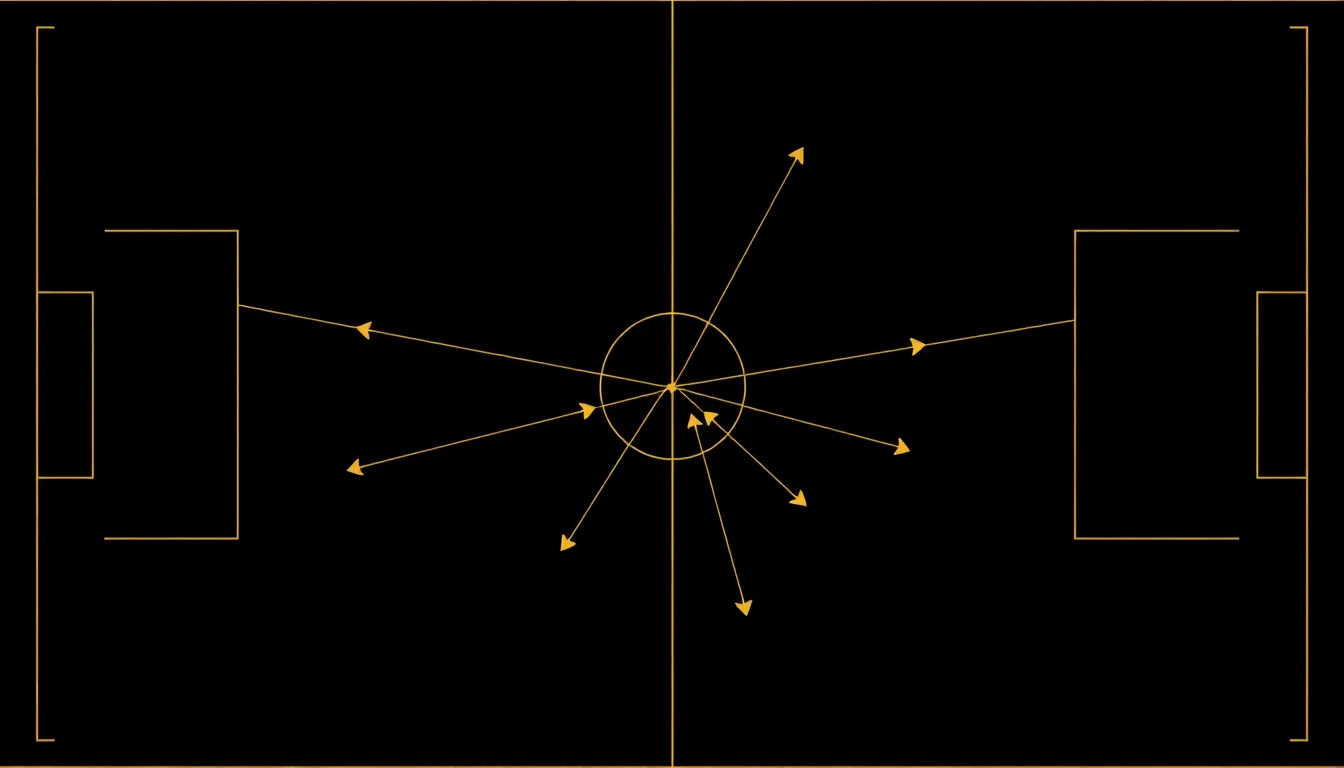
 Germany
We have been saying it since the group stage drew to a close: seeding is not a shield. Germany's position at the top of their group flatters a squad that has not yet been stress-tested by sustained pressing, and Ecuador arrives in the Round of 32 with the precise tactical toolkit to expose that gap. This is not pessimism about Germany. It is a structural observation, grounded in what the 2026 tournament has shown us so far, and in a pattern that has ended German campaigns before.
What Germany's midfield vulnerability actually looks like
The vulnerability is not about individual quality. Germany's central midfield contains technically capable players who can circulate the ball efficiently against low or mid-block opposition. The problem is ball-security under pressure: specifically, the ability to receive, shield, and redistribute the ball when an opponent compresses the space between the lines within two to three seconds of the pass leaving the goalkeeper or centre-back.
When a pressing team triggers in the first third, Germany's midfielders are asked to receive with their back to play, turn under pressure, and either play through or escape backward. Against the kind of staggered, wave-based pressing Ecuador demonstrated in the group stage, that sequence breaks down. Receivers lose orientation. Backward escapes push the ball into less secure zones. The front three, isolated ahead of the press, stop receiving meaningful ball. Germany's shape becomes two disconnected units: the midfield absorbing pressure, and the attack waiting for a delivery that does not arrive.
That is the structural exposure. It is observable in Germany's group-stage data, where their ball-circulation metrics dipped sharply during the few spells opponents applied sustained high-press sequences. Against sides that sat off, Germany looked fluid. Against pressure, the gaps appeared.
Ecuador's press is not just intensity, it is a system
Ecuador's group-stage performances demonstrated a pressing model built around coordinated triggers rather than individual effort. Their front line does not simply chase the ball carrier. They press in reference to the ball's position and the opponent's passing lanes, cutting off the central pivot first, then forcing the ball wide into zones where their secondary press unit can arrive before the receiving player can turn.
This is a disciplined, coachable system, and Ecuador executed it with consistency across multiple group-stage matches against varied opposition shapes. The press success rate, measured by ball recoveries within five seconds of a press trigger in the opponent's half, placed Ecuador among the tournament's most effective pressing sides in the group phase. Their press is not a high-energy gamble. It is a repeatable tactical mechanism.
When that mechanism meets Germany's build-up structure, the mismatch becomes clear. Germany's preference for playing through the thirds via central midfield, rather than bypassing the press with direct vertical balls, hands Ecuador exactly the scenario their shape is designed to exploit.
The historical pattern Germany cannot ignore
Germany's 2018 World Cup exit against South Korea and their elimination at Euro 2020 against England both followed a recognisable template. In both cases, opponents applied sustained high-press strategies that overwhelmed Germany's central midfield, disrupted their build-up rhythm, and left the front line functionally isolated. South Korea's energy in Kazan in 2018 was relentless, and Germany's midfield could not hold the ball long enough to shift the pressure. Against England at Euro 2020, the press was more structured, but the effect on Germany's central zone was identical: turnovers, disorientation, and a front line that received the ball in worse and worse positions as the game progressed.
Neither of those exits was framed at the time as a midfield-press vulnerability story. Both were processed as shocks, upsets, aberrations. But the same structural weakness ran through both. Ecuador, heading into this Round of 32 fixture, is the third consecutive major-tournament opponent with the pressing profile to exploit it.
Has Germany faced this in 2026?
This is the critical question, and the answer is no. Germany's group-stage opponents did not sustain high-press sequences against them for extended periods. Germany were able to circulate the ball in the first and second thirds without facing the kind of coordinated pressure Ecuador brings. That absence of adversity is not evidence of strength. It is a gap in the tournament record that Ecuador will fill.
Teams that have not been tested by sustained pressing in the group stage sometimes adapt quickly in the knockout rounds. Coaching staff can prepare for it, shape training to simulate the triggers, and adjust the build-up structure to include more direct vertical options that bypass the midfield press zone. Germany's coaching staff are experienced enough to identify the threat. The question is whether the players have the ingrained habits to execute a modified build-up under knockout pressure, in front of a full stadium, against a pressing team operating at peak intensity.
That is not a guarantee. Habit beats instruction in the moments that matter, and Germany's habit is to play through the middle.
The counter-argument: pedigree and depth win in knockouts
The strongest case for Germany dismissing this tactical concern rests on two pillars: tournament experience and squad depth. Germany have won the World Cup four times. Their players have operated under knockout pressure in European club competition at the highest level. When the game tightens and margins shrink, experience compounds. Ecuador have not reached this stage in the 2026 tournament before, and the argument runs that composure and pedigree will compensate for any tactical disadvantage in a single-elimination match.
Squad depth matters too. If Ecuador's press creates fatigue in Germany's midfield, Germany can introduce fresh legs from a deeper bench and change the game's physical balance in the second half or extra time. That substitution advantage is real.
We take both points seriously. But the historical pattern undermines them. Germany had tournament pedigree in 2018. They had squad depth in 2020. Neither protected their midfield from a pressing team willing to commit to the structure for ninety minutes. Experience reduces errors at set pieces and in one-versus-one defending. It does not automatically generate better press resistance if the build-up habits have not been rehearsed against that specific pressing shape.
What we expect on the day
We expect Ecuador to set their press triggers from the first whistle, targeting Germany's central pivot and forcing play wide and backward within the opening fifteen minutes. We expect Germany to find those escapes difficult, to concede possession in dangerous areas at least twice in the first half, and to look considerably less fluid than their group-stage performances suggested.
The result of that tactical imbalance is not predetermined. Germany are capable of scoring from set pieces, from individual quality in the final third, and from the kind of transitional moments that a high-press opponent occasionally surrenders when their shape is stretched on a rapid German counter. A match that Germany win on a set-piece goal while struggling in open play is entirely plausible.
But the structural story of this game will be written in midfield. Ecuador's press is the sharpest tactical instrument Germany have faced in this tournament, and Germany's midfield has not yet demonstrated the press resistance required to neutralise it. Seeding got Germany to this round. It will not get them through it.
This article was researched and drafted with AI assistance and reviewed by our editorial team.