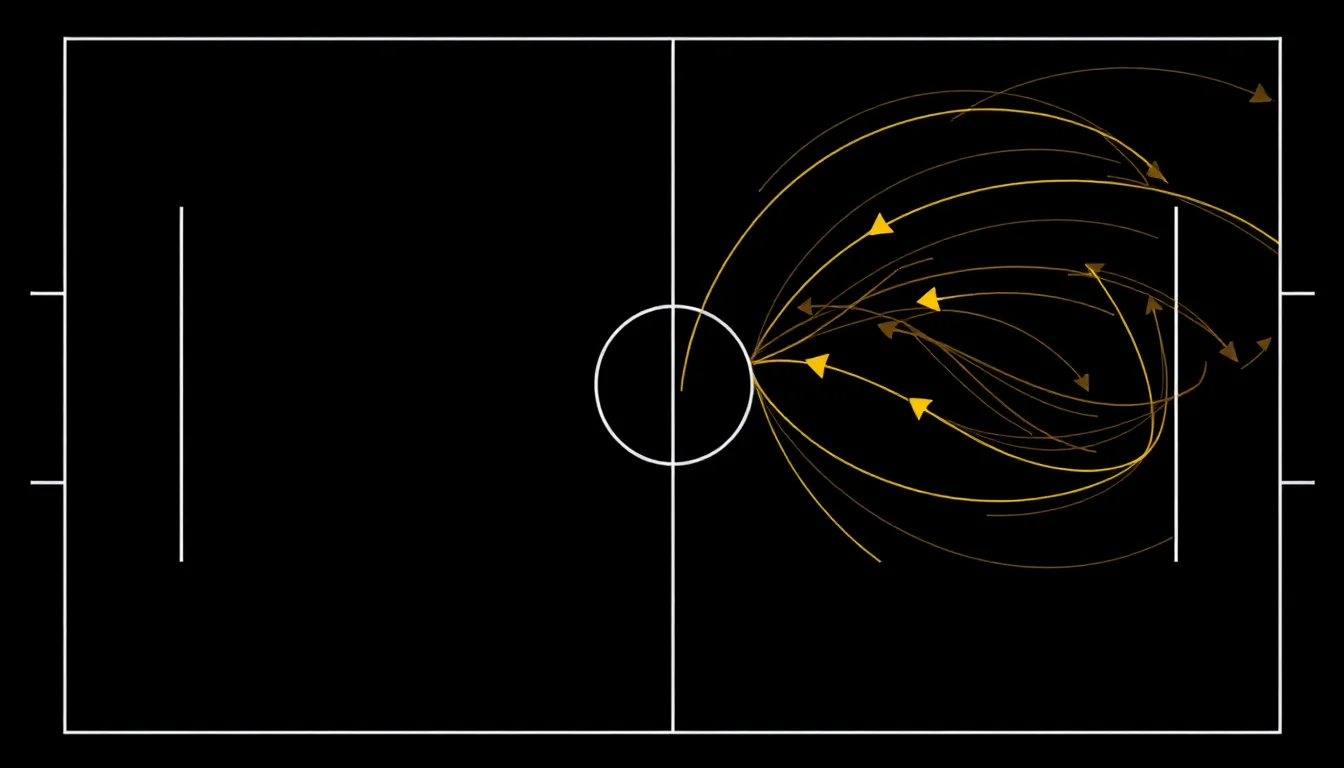
 Germany
The social media chatter has settled on one question: can Germany do a 7-1 again? We think that is the wrong frame. The right question is whether Germany's press, which leaks lateral space against compact defensive shapes, can actually be exploited by a Paraguay side that has shown precisely zero interest in attacking football. This match will not be a demolition or a war. It will be a tactical exercise in patience, and Germany will pass it, comfortably but not cinematically.
Germany's group stage form: power with a caveat
Germany's group stage performance generated some of the highest attacking output in the 2026 tournament. Their xG differential in three group matches placed them among the top four sides remaining in the competition, and their pressing structure, built on a high defensive line and aggressive zonal triggers, suffocated every team they faced. The goals flowed from central overloads, quick combinations in the half-space, and a back line that pushed high enough to compress play into a narrow strip of midfield chaos.
But the caveat is measurable. Germany's press operates on a man-plus-one logic in the central channel, which means their wide defenders frequently carry responsibility for large lateral zones. When an opposition side occupies those zones with width, Germany's shape momentarily stretches. Against Ecuador in the group stage, that stretch was visible twice in the first half, with Germany's right flank briefly exposed before the midfield adjusted. The structural fix came quickly, but the vulnerability exists, and any team with the personnel and intent to exploit it could find space.
Paraguay does not have that personnel. That is the central tension of this fixture.
Paraguay's defensive blueprint: survival as a strategy
Paraguay's group stage record tells a specific story. They conceded a small number of goals relative to the volume of pressure they absorbed. Their defensive actions per 90 minutes ranked near the top of the field. Their possession percentage ranked near the bottom. They did not attempt to play football in any conventional sense. They attempted to exist on a football pitch without dying, and in the group stage, that was enough to progress.
The low block Paraguay deployed was not a tactical masterstroke. It was a structural acknowledgment of the gap between their squad depth and the sides they faced. Their midfield offered no genuine press-breaking quality, and their forward line generated almost no meaningful attacking actions. Shots on target across three group games were minimal. Expected goals for across the group phase was among the lowest of any side to qualify from the group stage at this tournament.
This is relevant because it sets the terms of the Round of 32 encounter clearly. Paraguay's low block survival strategy works as a points accumulation tool when opponents are careless or fatigued. Against a Germany side playing at full intensity in a knockout match, it functions as a delay mechanism, not a game plan.
The 2014 comparison: useful context, wrong conclusion
The 2014 semi-final between Brazil and Germany produced a 7-1 scoreline that remains the most dominant knockout performance in modern World Cup history. Germany scored four goals in six second-half minutes against a Brazil side that had lost its defensive spine to suspension and injury, was playing at home under extraordinary psychological pressure, and collapsed structurally in a way that had no precedent or parallel.
Paraguay will not collapse. They have no psychological fragility triggered by absent talisman figures. They have no home-nation weight pressing down on them. They have a deeply rehearsed, deeply committed defensive structure that requires sustained, precise work to dismantle. The 7-1 comparison is a social signal, not a tactical prediction.
What the 2014 precedent does usefully demonstrate is that Germany in knockout football can shift from controlled dominance to explosive volume when the structural conditions allow it. The conditions against Paraguay do not obviously allow it. A more reasonable historical parallel might be Germany's earlier knockout wins where a well-organized lower-ranked side held the score respectable until the 70th minute before Germany's fitness and substitution depth pushed the margin to three.
Press vulnerability and what Paraguay cannot do about it
Germany's lateral press vulnerability is real but context-dependent. The flaw activates when an opposition side has the technical quality to receive the ball wide under pressure, carry it forward, and create overloads before Germany's shape recovers. Paraguay's midfielders have not demonstrated that quality at this tournament. Their wingers are primarily defensive workers. Their full-backs do not push forward.
So Germany has a structural weakness that Paraguay theoretically threatens, and Paraguay has a tactical identity that is entirely incompatible with exploiting it. The press vulnerability becomes irrelevant not because Germany fixed it, but because Paraguay cannot press the button.
This dynamic produces a specific kind of knockout match. Germany will have the ball for extended periods against a deep, narrow block. They will create chances through wide overloads and set-piece delivery rather than central combination play. The first goal will arrive somewhere between the 25th and 45th minute as Germany's patient buildup finds a moment of Paraguay positional discipline breaking. The second will come after the interval when Paraguay's physical endurance against a high press begins to decline.
The counter-argument: could this be closer than it looks?
The steelman version of a competitive Paraguay performance goes like this. Germany's tactical adjustment from the Ecuador group game was reactive rather than proactive, suggesting their coaching staff is correcting problems rather than anticipating them. Paraguay's low block, if maintained with discipline for 75 minutes, forces Germany into low-percentage wide deliveries and speculative shots. A single set-piece moment or a rare German error could put Paraguay level, at which point the psychological complexity of a knockout match changes everything.
That argument deserves respect. Knockout football compresses outcomes. The Round of 32 historically produces tighter scorelines than group stage results suggest, and teams with nothing to lose defensively are harder to break than their overall quality implies. Paraguay will make Germany work.
But the refutation is in the numbers. Paraguay's xG for across the group stage provides almost no basis for believing they can manufacture a genuine goal-scoring opportunity against a Germany back line that has been among the most organized in the tournament. A single German error giving Paraguay a chance is possible. Paraguay manufacturing a chance through their own attacking play is not supported by any evidence from this competition. You cannot hold a 1-0 lead if you cannot score the goal that makes it 1-0.
Our verdict: Germany in, comfortable but not historic
We are not buying the 7-1 narrative. Paraguay will not provide the structural or psychological collapse that made 2014 possible. What they will provide is 60 minutes of stubborn resistance followed by a second-half breakdown as Germany's fitness and pressing intensity compounds.
Our prediction is Germany 3-0, with the scoreline flattering Paraguay's second-half defensive effort and understating Germany's territorial dominance across the full 90 minutes. The match will not generate the viral moments or historic scorelines that social media is anticipating. It will confirm Germany as serious knockout contenders, expose nothing new about their press vulnerability because Paraguay cannot activate it, and send Paraguay home having done exactly what their squad was capable of doing: surviving longer than expected, winning nothing.
Germany's knockout trajectory from here depends on the next round, where a side with actual attacking quality could finally press that lateral button. Paraguay will not be the story of this 2026 tournament. Germany, for better or worse, might be.
This article was researched and drafted with AI assistance and reviewed by our editorial team.